
www.oilgastechnology.com
18
'26
Written on Modified on
TNB Remaco produces reverse-engineered open impeller using hybrid metal 3D printing
Combining Meltio's wire-laser metal deposition with CNC machining, the company is building an in-house route for low-volume, high-value or time-critical spare parts.
www.meltio3d.com
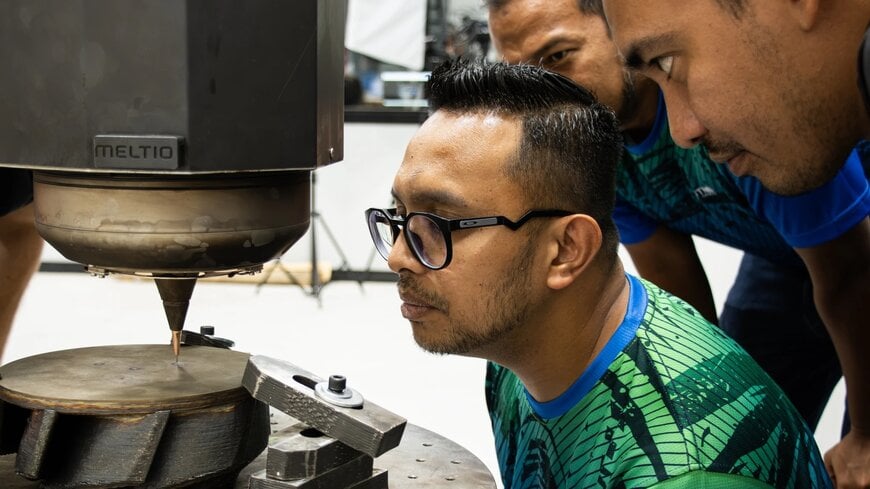
TNB Remaco, which supports critical assets in power generation and Oil & Gas, has reverse-engineered an open impeller and produced it in stainless steel 316L using Meltio's wire-laser metal deposition process, followed by CNC machining to achieve the required final geometry. The project explored whether metal additive manufacturing could provide an additional route for low-volume, high-value or time-critical spare parts while maintaining the reliability and engineering discipline required for industrial applications. For this impeller, the conventional route of sourcing material and then machining took TNB Remaco approximately one month for material sourcing and another month for machining, a lead time of around two months before the part was ready for the next stage. The company, which has developed spare parts through reverse engineering for many years using casting, machining, welding, surface treatment and heat treatment, aims to add another option where it offers a technical or lead-time advantage, following a strategy of manufacturing parts when they are unavailable and repairing them when they can be economically restored.
Near-net-shape printing and CNC finishing
TNB Remaco considers that every manufacturing technology has its place: casting remains effective where production volumes justify tooling, while CNC machining provides the dimensional accuracy and surface finish required for precision components. For this impeller, the company reverse-engineered the geometry, produced a near-net-shape component in SS316L by wire-laser deposition and then finish-machined it on CNC equipment to achieve the required tolerances and surface finish. TNB Remaco is implementing a Meltio Robot Cell for this capability. The robotic configuration provides flexibility to plan deposition strategies around different component geometries and supports future applications such as repair and cladding. As the process uses welding wire rather than metal powder, it fits with the company's existing welding and fabrication environment and gives access to commonly available industrial wire materials.
Qualification before service
The finished impeller weighs approximately 11 kg and demonstrated a complete workflow from reverse-engineered geometry through additive manufacturing to CNC finishing. TNB Remaco is treating it as a demonstration and validation component rather than assuming it is ready for service. Penetrant inspection is planned after machining to check for surface-breaking defects, and mechanical property testing is scheduled to establish material performance before the component is considered for full service, as additive manufacturing must meet the same engineering expectations as any other manufacturing route.
A broader spare-part capability
The impeller is an early demonstration of a broader capability that brings together reverse engineering, 3D scanning, additive manufacturing, CNC machining, metallurgy and inspection, with the aim of selecting the most appropriate manufacturing route for each spare part. The initial focus is power generation, with potential applications in the Oil & Gas, petrochemical, marine and heavy engineering sectors supported by TNB Remaco. As industrial assets age and some components become obsolete or difficult to source, the company sees a longer-term opportunity to combine reverse engineering and digital part information with flexible manufacturing technologies, supporting just-in-time manufacturing and faster response for critical spare parts as an alternative to simply maintaining large inventories.
Additional Context:
This section explains general principles of wire-based directed energy deposition not included in the original press release.
Wire-laser metal deposition belongs to the family of directed energy deposition processes, in which metal is melted at the point where it is added to the part. A laser creates a small melt pool, metal wire is fed into it, and the deposition head or robot moves along a programmed path to build the component bead by bead and layer by layer.
Because the as-deposited surface is not smooth enough for most functional surfaces, parts are usually built slightly oversized as a near-net shape and then machined to their final dimensions. Inspection methods such as dye penetrant testing, together with mechanical testing of the deposited material, are commonly used to qualify such parts before they are put into service.
Edited by an industrial journalist, Lekshman Ramdas, with AI assistance.
www.meltio3d.com
