
www.oilgastechnology.com
16
'26
Written on Modified on
Behind-the-Meter Power Generation for Industrial LNG Facilities
Baker Hughes, Venture Global, and GE Vernova establish a framework supplying sixteen modular power islands to stabilise industrial liquefaction loads.
www.bakerhughes.com
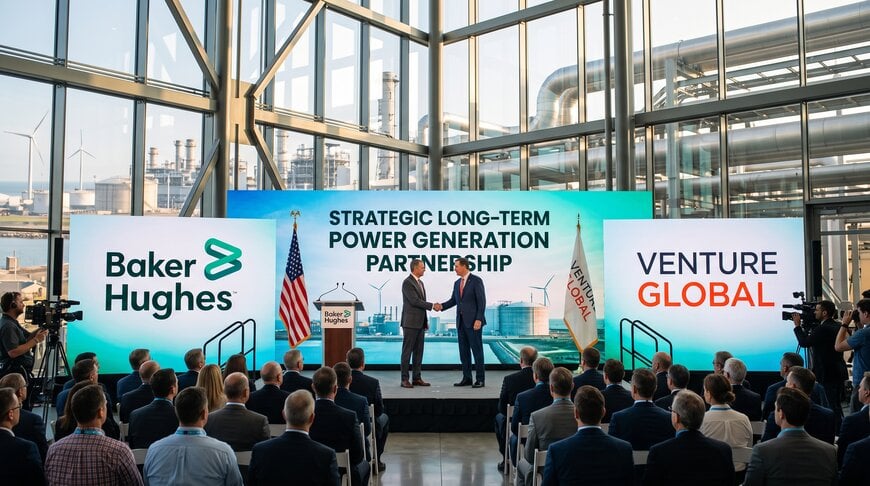
Baker Hughes, Venture Global, and GE Vernova have concluded a power frame agreement to engineer and deploy on-site power generation systems across industrial facilities in the United States. The engineering initiative provides dedicated electrical capacity for liquefied natural gas production plants and planned data center infrastructure located adjacent to liquefaction sites.
Industrial Power Demands in Liquefaction Operations
Operating baseload LNG refrigeration trains requires uninterrupted electrical output and high mechanical drive stability. Grid interconnection constraints and regional transmission capacity limits present risks to high-draw processing equipment. To mitigate grid-dependency bottlenecks, the participating operators require isolated generation units configured to balance localized load variations from heavy cryogenic compression cycles.
Modular Architecture and Engineering Responsibilities
The framework standardizes the procurement and configuration of up to 16 power island units. The generation package incorporates gas turbines, steam turbines, and balance-of-plant mechanical assemblies. Equipment sourcing leverages the combined machinery manufacturing capabilities of GE Vernova and Baker Hughes.
System integration focuses on control topology and distribution. Baker Hughes manages the operational control architecture, engineering the integrated electrical control systems and prefabricated electrical houses. The modular enclosures house switchgear, variable frequency drives, and automated control platforms required to govern turbine response times during sudden ramp-ups in process demand. This combined-cycle architecture captures waste heat from the combustion turbines to power the secondary steam cycle, increasing thermodynamic efficiency across the isolated network.
Implementation Timeline and Phased Deployment
The deployment reproduces a pre-engineered power island configuration previously commissioned for Venture Global processing facilities. This repeatable design eliminates custom engineering iterations for balance-of-plant interfaces, shortening procurement lead times.
Initial procurement begins with an expected equipment order in 2026, followed by recurring equipment orders starting in 2027. Primary hardware shipments, on-site commissioning, and grid synchronization activities are scheduled across a multi-year execution window extending from 2028 through 2034.
Operational Impact on Energy-Intensive Infrastructure
The autonomous power islands isolate primary refrigeration machinery from external grid disruptions, preventing unscheduled shutdowns across the liquefaction process trains. For digital infrastructure planned near the gas facilities, localized generation secures consistent baseload supply for compute clusters without overburdening public transmission lines.
Lorenzo Simonelli, Chairman and CEO of Baker Hughes, stated that behind-the-meter power generation has emerged as a critical component to LNG operations, noting that the framework is structured to develop power at scale.
By standardizing core turbo-machinery packages, the engineering partners establish a repeatable blueprint for behind-the-meter power generation supporting large-scale processing facilities and collocated computing operations.
Edited by Evgeny Churilov, Induportals Media - Adapted by AI.
www.bakerhughes.com
