
www.oilgastechnology.com
02
'26
Written on Modified on
Modular Gas Treatment Skid Upgrades Methane Streams
PSB Industries has introduced an immediately available Gas Chilling, Deoxygenation and Dehydration Skid designed for pipeline-specification conditioning of landfill gas and renewable natural gas.
psbindustries.com
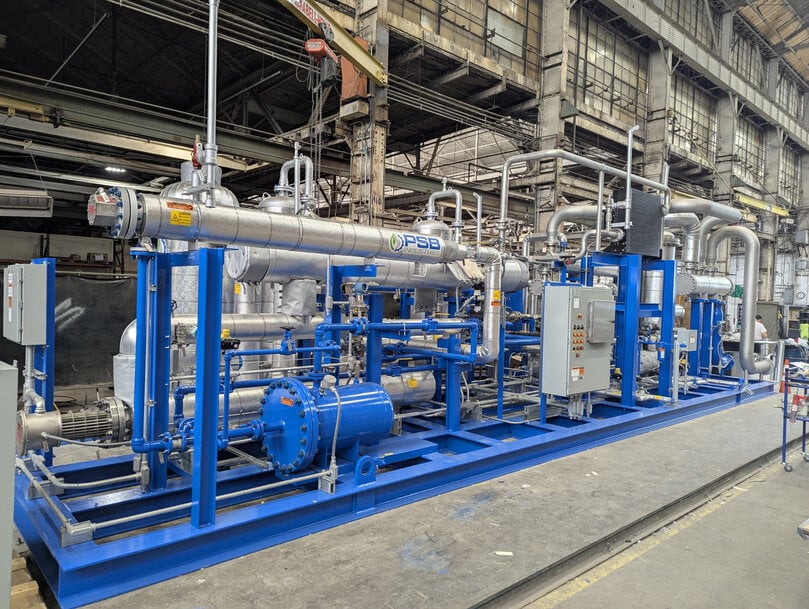
Raw biogas and high-methane landfill gas streams frequently carry significant concentrations of moisture, oxygen, and trace contaminants that accelerate transport pipeline corrosion and violate strict injection standards. To upgrade these variable streams into pipeline-quality fuel, processing facilities must combine precise bulk water knock-out, catalytic conversion of oxygen, and deep desiccant dehydration within an integrated, tightly regulated operating envelope.
Integrated Architecture for Rapid Plant Interconnection
Upgrading biogas into compliant renewable natural gas requires multi-stage conditioning capable of handling fluctuating raw feed compositions without tripping downstream equipment. The factory-assembled system engineered by PSB Industries addresses these operational bottlenecks by integrating gas chilling, precious-metal catalytic deoxygenation, and deep desiccant drying onto a single transportable footprint. By completing factory acceptance testing and pre-wiring prior to site delivery, the platform eliminates lengthy on-site assembly schedules typical of custom gas processing plants while ensuring full operating compliance under fluctuating feed conditions.
Inlet Gas Chilling and Bulk Condensate Separation
The skid operates via a three-stage mechanical and chemical separation process engineered for throughputs between 600 and 1,200 standard cubic feet per minute, sustaining turndown to 600 standard cubic feet per minute without degrading outlet specifications. In the initial stage, incoming gas enters a gas-to-gas shell-and-tube economizer followed by a chilled-water trim cooler that drops the stream temperature to 40 degrees Fahrenheit. Condensed liquids fall out across a dedicated knockout vessel equipped with a high-efficiency demister pad and automated drain traps, after which the dry stream is reheated against warm process gas to eliminate risk of line condensation downstream.
Precious-Metal Catalytic Deoxygenation Workflow
The second stage handles deoxygenation. The gas passes through a protective guard bed designed to catch upstream catalyst poisons before entering an economizer and a 90-kilowatt electric trim heater that elevates stream temperature to catalytic ignition thresholds. In the primary reactor bed, an unloaded precious-metal catalyst, supported on ceramic media, reacts trace oxygen with methane and hydrogen to produce carbon dioxide and water vapor, driving inlet oxygen concentrations of 0.4 mole percent down to an outlet volume under 0.1 percent. Exiting gases pass through an air-cooled exchanger, a chilled-water trim cooler, a liquid separator, a dust filter, and a dedicated startup recycle line that manages thermal equilibrium and recirculates off-spec gas during commissioning.
Twin-Tower Temperature Swing Adsorption Drying
Final polishing occurs across a twin-tower temperature swing adsorption drying system. Gas enters through a coalescing prefilter, flows downward through one desiccant tower to strip deep moisture, and exits through a particulate afterfilter to yield an absolute moisture content below 7 pounds per million standard cubic feet. The parallel tower undergoes thermal regeneration through a closed loop powered by a variable-frequency-drive blower and a 35-kilowatt electric regeneration heater, providing continuous uninterrupted flow.
Pressure Vessel Specifications and Control Automation
Fabricated under ASME Section VIII specifications with a 200 pounds per square inch gauge vessel rating, the package operates between 130 and 170 pounds per square inch gauge across the deoxygenation and dryer vessels at peak volumetric flow. Electrical architectures comply with Class I, Division 2 hazardous area requirements utilizing NEMA 4 outdoor-rated enclosures engineered for ambient conditions spanning minus 20 to 100 degrees Fahrenheit. Skid-mounted continuous oxygen and moisture analyzers tie directly into an onboard programmable logic controller and human-machine interface, providing automated stream isolation, protective alarms, and integrated I/O points for supervisory control and data acquisition networks. The structural base measures 480 inches in length, 144 inches in width, and 139 inches in height, with a total dry assembly weight of 49,125 pounds.
Target Applications Across Biogas and Natural Gas Conditioning
The modular architecture targets renewable natural gas developers, landfill gas-to-energy projects, and industrial natural gas operators requiring rapid deployment for pipeline interconnection. Because the assembly is pre-tested and complete with remote 460-volt power distribution, relief stacks, process drawings, and palletized catalyst media, facilities avoid multi-month engineering lead times while meeting strict pipeline water and oxygen thresholds.
Additional Context:
This section details technical specifications and competitive benchmarking not included in the original product announcement.
In typical North American renewable natural gas pipeline interconnections, transmission pipeline operators enforce strict tariff limits requiring oxygen levels under 0.1 to 0.2 percent by volume and water vapor levels between 4 and 7 pounds per million standard cubic feet to mitigate carbonic acid and microbial-induced corrosion in carbon steel pipe networks. Standard biogas treatment facilities traditionally deploy standalone temperature swing adsorption units or chemical scavengers; however, single-bed scavengers incur significant recurring operating expenditures through periodic chemical replenishment, whereas multi-tower catalytic systems run continuously with lower ongoing consumable costs.
Catalytic deoxygenation platforms across this throughput scale typically compete with membrane separation and cryogenic fractionation trains. While selective polymeric membranes provide concurrent carbon dioxide and oxygen bulk separation, they often exhibit limited selectivity between oxygen and methane, incurring higher methane slip penalties compared to fixed-bed precious-metal deoxidation catalysts, which convert oxygen at efficiencies exceeding 99 percent without volume methane loss. Desiccant dryers utilizing molecular sieve 3A or 4A media, combined with closed-loop thermal regeneration blowers, match or exceed the performance of competing open-loop purge desiccant systems, which can vent between 5 and 15 percent of conditioned product gas to the atmosphere.
Edited by Sucithra Mani, Induportals editor – adapted by AI.
www.psbindustries.com
