
www.oilgastechnology.com
20
'26
Written on Modified on
Three-Skid Cryogenic Pump Architecture Targets Large LNG-Fuelled Container Ships
Vanzetti Engineering expands its VT-3 range with a modular configuration that matches pump flow to the vessel’s operating profile and maintenance needs.
www.vanzettiengineering.com
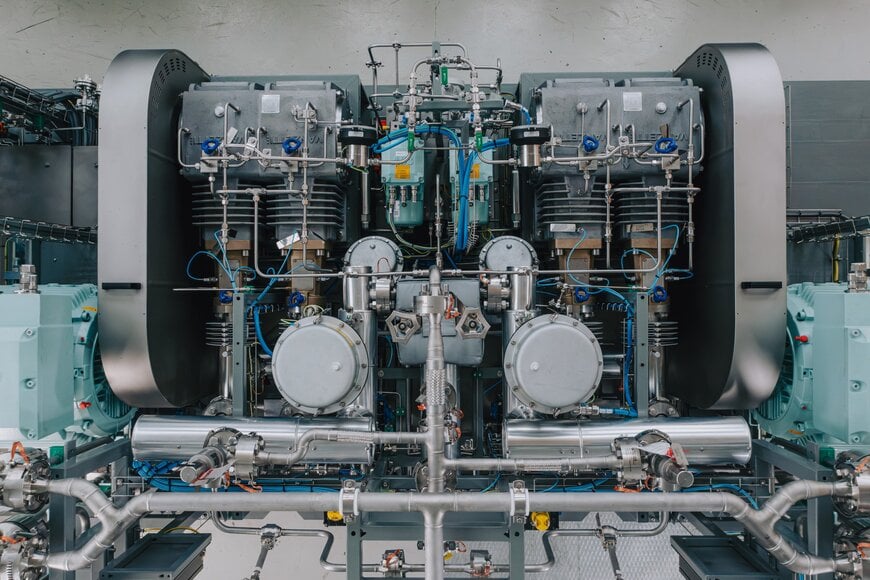
Vanzetti Engineering has developed the 3-Skid Architecture for its VT-3 high-pressure cryogenic pump to meet the requirements of large container ships. The new configuration increases the available flow rate and introduces modular pump management to optimise fuel consumption, maintenance and on-board space, and has already been supplied to several shipowners.
From 2x100% Redundancy to a Three-Skid Configuration
The solution complements the traditional 2x100% architecture, in which two skids are each sized to meet the engines’ full fuel supply demand, with the second kept in reserve. The new architecture uses three units: two can operate individually or in parallel depending on the required flow, while the third remains on standby.
The development is part of the evolution of the VT-3 range, whose maximum flow rate per skid has increased from 9 to 11 m³/h and then to 12.5 m³/h through product development and the introduction of new cold ends. In parallel, the company introduced the Mirrored Skid configuration, which combines two skids in a 2x100% arrangement on a single base frame with an optional integrated vaporiser, developed mainly for the Korean and Chinese marine markets. The 3-Skid Architecture enables higher flow rates than the two-skid solution and lower minimum flow rates for the same maximum flow.
Flow Rate Matched to the Operating Profile
In the 3x50% configuration, each skid supplies 50% of the maximum flow required by the engine fuel supply system. Below this threshold, one skid is sufficient; as demand rises, a second unit starts to reach 100% of the required flow, as if the pumping system had a “gearbox”, while the third skid remains in reserve. This allows the number of operating pumps to follow actual conditions such as slow steaming or port operations, which require significantly lower flow rates.
The architecture can also be adapted with 3x60% or 3x70% configurations. With the maximum flow of 12.5 m³/h per skid, two units in parallel reach 25 m³/h while the third is held in reserve.
“With the new three-skid architecture, we wanted to meet the needs of large container ships, which require ever higher flow rates but often operate at loads below their maximum design values,” explains Federico Buono, Marine Business Unit Manager at Vanzetti Engineering. “The ability to activate one or two pumps according to actual engine demand allows flow to be managed more efficiently and offers shipowners tangible benefits in terms of both consumption and maintenance costs.”
Limiting Boil-Off Gas and Operating Costs
In high-pressure cryogenic pumps, running units sized for high flow rates when actual demand is low can generate more boil-off gas (BOG) than necessary. By activating a single skid when demand allows and adding the second only when needed, modular management limits BOG generation, with benefits for energy consumption and potential greenhouse gas emissions. Distributing operating hours across the units also offers advantages in maintenance planning and operating costs (OPEX) for the shipowner.
Control Logic Validated Through Dedicated Tests
Unlike the 2x100% architecture, the 3-Skid Architecture requires two units to be managed in simultaneous operation. Vanzetti Engineering carried out dedicated tests on the control logic, including in the presence of shipowner representatives, verifying the start-up of the second pump as engine demand increases and the speed coordination of both units so that the transition from one to two skids does not interfere with the required flow progression. The results also provided technical feedback to fuel gas system suppliers, who are generally responsible for the control logic of the entire fuel supply system.
Flexible Integration in the Engine Room
Compared with a single large system, three independent skids can be distributed more flexibly within the engine room to suit available space and layout constraints. Vanzetti Engineering also offers the option of installing additional control valves directly on the individual skids, components that in traditional configurations may require dedicated external modules; shipyards and fuel gas system suppliers can thus optimise equipment layout and reduce the need for separate auxiliary skids. Configurations are available with or without integrated valves.
“With the new 3-Skid Architecture, Vanzetti Engineering consolidates the evolution of its high-pressure cryogenic pump range, covering all the flow rates and redundancies required by the market and providing the marine sector with modular solutions that can be configured according to flow rates, the ship’s operating profile and on-board installation conditions,” comments Federico Buono.
Ongoing VT-3 developments include a new crank mechanism and new cold ends capable of withstanding higher loads, to reach flow rates of up to 18 m³/h, also with the 2x100% architecture.
Additional Context
This section details technical specifications and competitive benchmarking not included in the original news release.
High-pressure marine fuel gas supply systems for two-stroke dual-fuel engines (such as MAN Energy Solutions ME-GI propulsion systems) typically require LNG pressurization to approximately 300 bar. A comparable reciprocating cryogenic pump platform in this segment is Cryostar’s HPP (High-Pressure Pump) series, which also utilizes multi-cylinder cold ends for 300-bar marine service and is deployed in redundant multi-skid arrangements to match vessel load profiles. While both manufacturers address high-capacity container ship propulsion with modular reciprocating pump skids, Vanzetti Engineering’s 3-Skid Architecture specifically combines 12.5 m³/h VT-3 units for up to 25 m³/h of parallel output with optional onboard control valve integration and an active development roadmap toward 18 m³/h per skid.
Edited by Aishwarya Mambet, Induportals Editor, with AI assistance.
www.vanzettiengineering.com
