
www.oilgastechnology.com
23
'26
Written on Modified on
Hydrogen Gas Pipeline Transport Engineering Collaboration
Kawasaki Heavy Industries and Transgaz deploy the KM Comp-H2 centrifugal compressor to establish onshore hydrogen pipeline transmission infrastructure across Eastern Europe.
www.kawasakirobotics.com
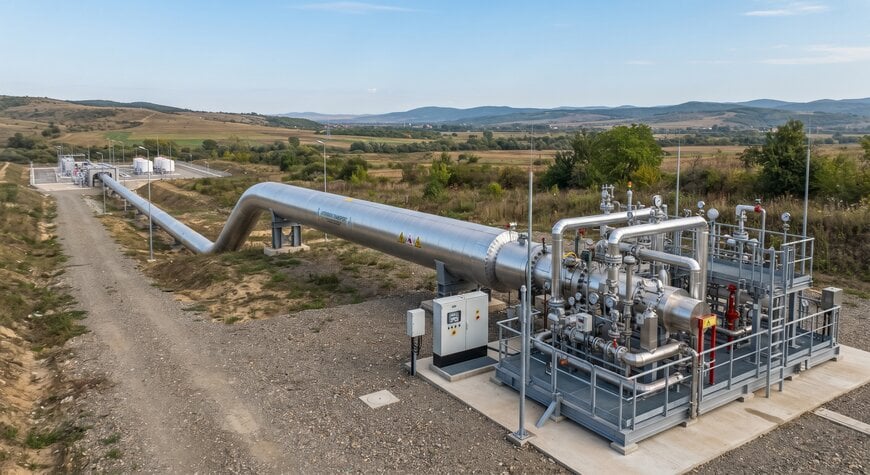
Kawasaki Heavy Industries and Romanian natural gas transmission system operator Transgaz have signed a strategic partnership to develop large-scale onshore hydrogen gas transport infrastructure across Central and Eastern Europe. The engineering initiative evaluates the integration of specialized compression machinery directly into regional pipeline networks to transport pure hydrogen gas.
Technical Challenge in Hydrogen Compression
Pipeline transmission provides an efficient method for moving high volumes of industrial gas over long distances, but pure hydrogen presents distinct aerodynamic and thermodynamic challenges. Due to hydrogen's low molecular weight and low gas density, conventional transmission compressors require exceptionally high impeller tip speeds to achieve the necessary pressure ratios. Compressing high volumetric flows to transmission pressure within limited facility footprints requires aerodynamic optimization to maintain continuous mass flow and mechanical integrity.
Partnership and Division of Responsibilities
The cooperation leverages the complementary domain expertise of both organizations to validate mechanical systems under field conditions. Transgaz provides operational network architecture, grid integration parameters, and transmission system access. Kawasaki Heavy Industries supplies the mechanical compression system, contributing engineering data from high-pressure rotational equipment development.
The initial phase deploys Kawasaki's KM Comp-H2 centrifugal hydrogen compressor for field demonstration tests in Romania. The project, designated as the "Romania / Hydrogen Supply Chain FS Demonstration Project: Centrifugal Hydrogen Compressor for Onshore Hydrogen Gas Transport," is supported by the Ministry of Economy, Trade and Industry (METI) of Japan.
System Function and Implementation
Centrifugal compressors achieve pressure elevation by converting rotational kinetic energy from dynamic impellers into static pressure energy within stationary diffusers. In pure hydrogen applications, the KM Comp-H2 system is engineered to deliver high volumetric flow rates while sustaining process pressures required for transmission pipelines.
The deployment focuses on integrating the compressor station into onshore infrastructure to verify process stability, seal integrity, and pressure management during continuous feed. The trials assess steady-state operations, dynamic response across variable flow regimes, and compatibility with downstream regional distribution nodes.
Industrial Application and Operational Impact
The joint initiative targets the energy transmission sector, industrial chemical feedstocks, and regional power generation hubs requiring continuous high-volume fuel delivery. Establishing stable compression mechanisms addresses the primary technical barrier to pipeline transport, lowering specific energy consumption during fuel transit.
Operating high-capacity centrifugal machinery on onshore networks provides an engineering baseline for multi-country transmission grids. The operational data gathered will define baseline standards for equipment footprint, compressor staging, and network pressure stability across future hydrogen infrastructure projects.
Edited by Evgeny Churilov, Induportals Media - Adapted by AI.
www.global.kawasaki.com
