
www.oilgastechnology.com
16
'26
Written on Modified on
Multiphase Slurry Modelling for Ultra-Long Subsea Tiebacks
LedaFlow Technologies, ConocoPhillips, TotalEnergies, Vår Energi, Falkor and SINTEF Industry develop HyWax slurry transport models to manage wax and hydrates in long tiebacks.
www.kongsbergdigital.com
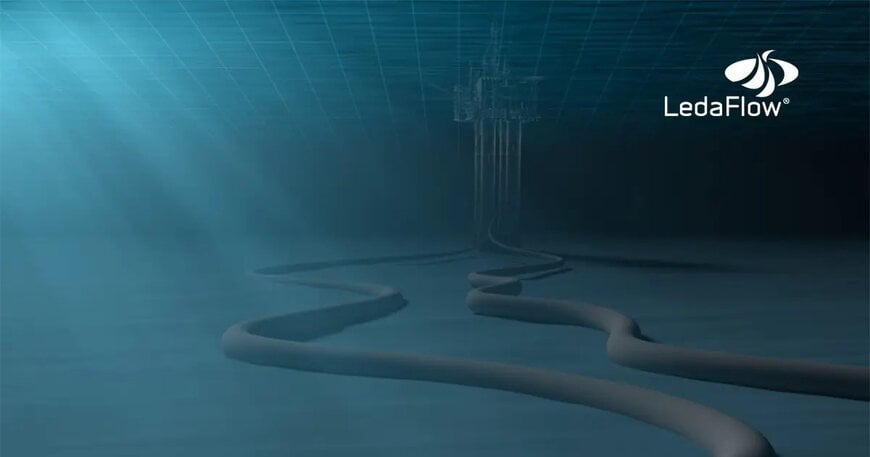
LedaFlow Technologies has formed the HyWax research consortium with ConocoPhillips, TotalEnergies, and Vår Energi, alongside technology partners Falkor (formerly Kongsberg Digital) and SINTEF Industry, to develop multi-component slurry transport models for the LedaFlow multiphase flow simulator. Supported by the Research Council of Norway, the project addresses flow assurance for ultra-long subsea tiebacks in offshore oil and gas production.
Flow assurance limits in long subsea tiebacks
The longest subsea tiebacks currently in operation reach roughly 60 km for oil fields—with most considerably shorter—and around 200 km for gas fields. The limiting factor is flow assurance: as unprocessed hydrocarbons cool over long distances, wax precipitates and gas hydrates agglomerate, creating a risk of pipeline blockage.
Operators have traditionally addressed this with fixed platforms or Floating Production Storage and Offloading (FPSO) units that process fluids locally, or through pipeline heating, large volumes of chemical injection, and frequent pigging. These measures increase capital and operating costs, consume energy, interrupt production, or introduce environmental risks.
Partner roles in the HyWax consortium
LedaFlow Technologies is developing the slurry transport models within its LedaFlow simulator. SINTEF Industry contributes its experimental infrastructure, including advanced multiphase flow loops at the Tiller facility, and its Cold-Flow research, conducted and validated since the late 1990s. ConocoPhillips, TotalEnergies, and Vår Energi provide field operating data and operational expertise, while Falkor brings the commercialisation model it has applied to LedaFlow since 2010.
From deposit avoidance to controlled slurry flow
Rather than attempting to prevent wax and hydrate deposition altogether, HyWax manages them as a controlled, flowable slurry. The models are designed to predict multi-component slurry flow behaviour so engineers can identify safe operating limits, optimise chemical usage, and assess transport through ultra-long direct tiebacks with limited pipeline insulation. The LedaFlow HyWax models will be delivered as industrial-grade software and integrated into digital twins to support real-time asset operations and predictive maintenance.
Expected impact on offshore field development
By converting wax and hydrates into a stable slurry, significantly extended tiebacks could enable direct-to-shore subsea pipelines, reducing reliance on floating structures and local processing, lowering capital expenditure, and cutting lifecycle carbon emissions. Vanessa Richon, TotalEnergies representative and LedaFlow Board Member, states that "direct-to-shore slurry transport models could potentially save several hundred million dollars on a single offshore project by reducing capital expenditure during development and lowering energy use throughout production."
"The HyWax consortium is a central piece of our long-term strategy to enable and de-risk ultra-long tieback solutions," says Jan Gerhard Norstrøm, Managing Director at LedaFlow Technologies DA. "It delivers on our vision to bring next-generation physics closer to actual simulator execution, de-risking low-emission production at a significantly lower cost.
Edited by Sucithra Mani, Induportals editor – adapted by AI.
www.falkor.com
