
GPSC 2026: process safety and crisis readiness in high-hazard industries
Running from 23 to 26 November 2026, GPSC 2026 brings together process safety, asset integrity, and risk management professionals to advance operational resilience across high-hazard industries.
gpscglobal.com
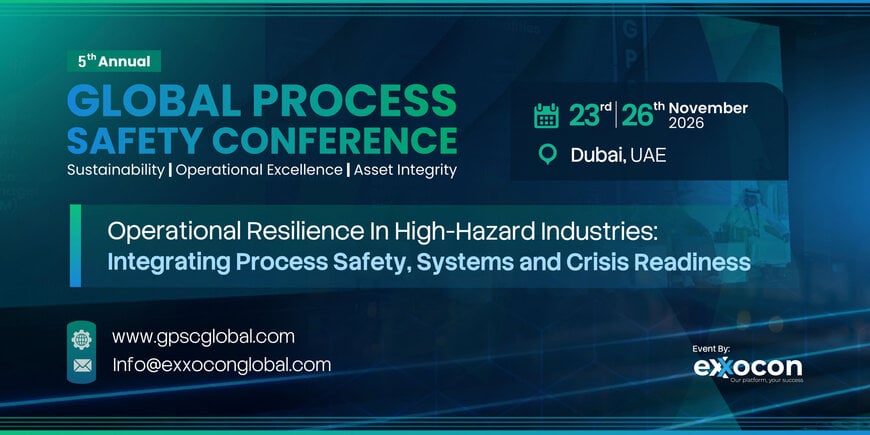
The Global Process Safety Conference (GPSC) 2026 is currently taking place in Dubai, United Arab Emirates, running from 23 to 26 November 2026. The industry gathering convenes professionals across process safety, asset integrity, operations, maintenance, health, safety, security, and environment (HSSE), emergency response, and risk management to examine the strategies, technologies, and practices shaping safer and more resilient high-hazard industries.
Addressing critical risks across modern industrial operations
Centred around the theme "Operational Resilience in High-Hazard Industries: Integrating Process Safety, Systems, and Crisis Readiness," GPSC 2026 focuses on core challenges confronting contemporary industrial facilities. Key programme pillars include process safety and operational risk, asset integrity and mechanical reliability, digital process safety, emergency preparedness, operational technology (OT) cybersecurity, human factors, and emerging energy risks.
Technical sessions, executive panels, and post-conference workshops
Across its four-day schedule, GPSC 2026 features strategic keynote addresses, technical case studies, high-level panel sessions, executive leadership discussions, and post-conference workshops. The agenda is structured to deliver practical insights, field experiences, and strategic frameworks addressing the operational realities of managing industrial risk and reinforcing organisational resilience.
With active participation from major operators, regulators, consultants, technology providers, and senior industry specialists, the event serves as a collaborative forum to exchange operational knowledge, evaluate emerging technologies, and identify practical approaches to strengthening safety, reliability, and business continuity.
Additional Context:
This section explains general principles of process safety management and operational technology convergence in high-hazard facilities not included in the original release.
Unlike occupational safety—which focuses on preventing individual worker injuries such as slips, falls, or mechanical contact—process safety engineering targets low-frequency, high-consequence events such as fires, explosions, and toxic chemical releases in sectors like oil and gas, petrochemicals, and power generation. Modern process safety relies on multi-layered barriers, combining inherently safer design, basic process control systems (BPCS), independent safety instrumented systems (SIS) rated to IEC 61511 standards, and mechanical pressure relief devices.
As industrial facilities digitise asset integrity monitoring and connect distributed control systems to enterprise networks, operational technology (OT) cybersecurity has become inseparable from functional safety. Protecting programmable logic controllers (PLCs) and safety shutdown loops from cyber intrusion, alongside integrating human factors engineering into control room alarm management, ensures that automated safety barriers remain reliable during abnormal process transients.
Edited by an industrial journalist, Lekshman Ramdas, with AI assistance.
